|
1
|
- Amalia Leona Dee Anderson
- Luther College, Decorah IA
- Advisor: Dr. John Pellegrino
- Graduate Student: Craig Gorman
- University of Colorado at Boulder
- Environmental Engineering REU
|
|
2
|
- Semi-permeable membranes are used increasingly for the separation of
matter from water in its treatment and purification
- Membranes are used in water treatment to remove some form of matter from
the water
- There is not a standardized system for membrane testing
- Meaningful comparison requires standard parameters for membrane testing
- Currently comparison relies on testing outside of the manufacturer
|
|
3
|
- The intent of this research was to take measurements of the diffusion of
salt occurring across various membranes in order to extract the
diffusion coefficient for each membrane tested. Commercial electrodialysis membranes
and reverse osmosis membranes made in the lab were to be analyzed.
|
|
4
|
- Porous membranes used in pressure driven filtration act as a grating and
use a pressure gradient that blocks any particles larger than its
pores. Examples: microfiltration
and nanofiltration
- Nanofiltration and reverse osmosis membranes also rely on pressure but
solvent and solutes move through the membranes by diffusion
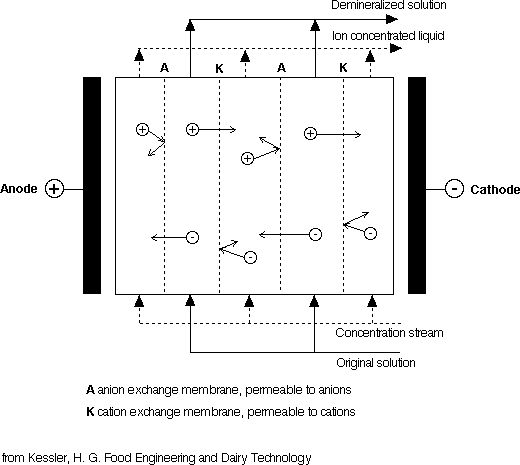
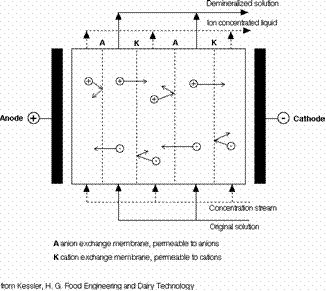
- Electrodialysis membranes use an electrical potential and a
sophisticated chemistry in order to transport the ions selectively
|
|
5
|
|
|
6
|
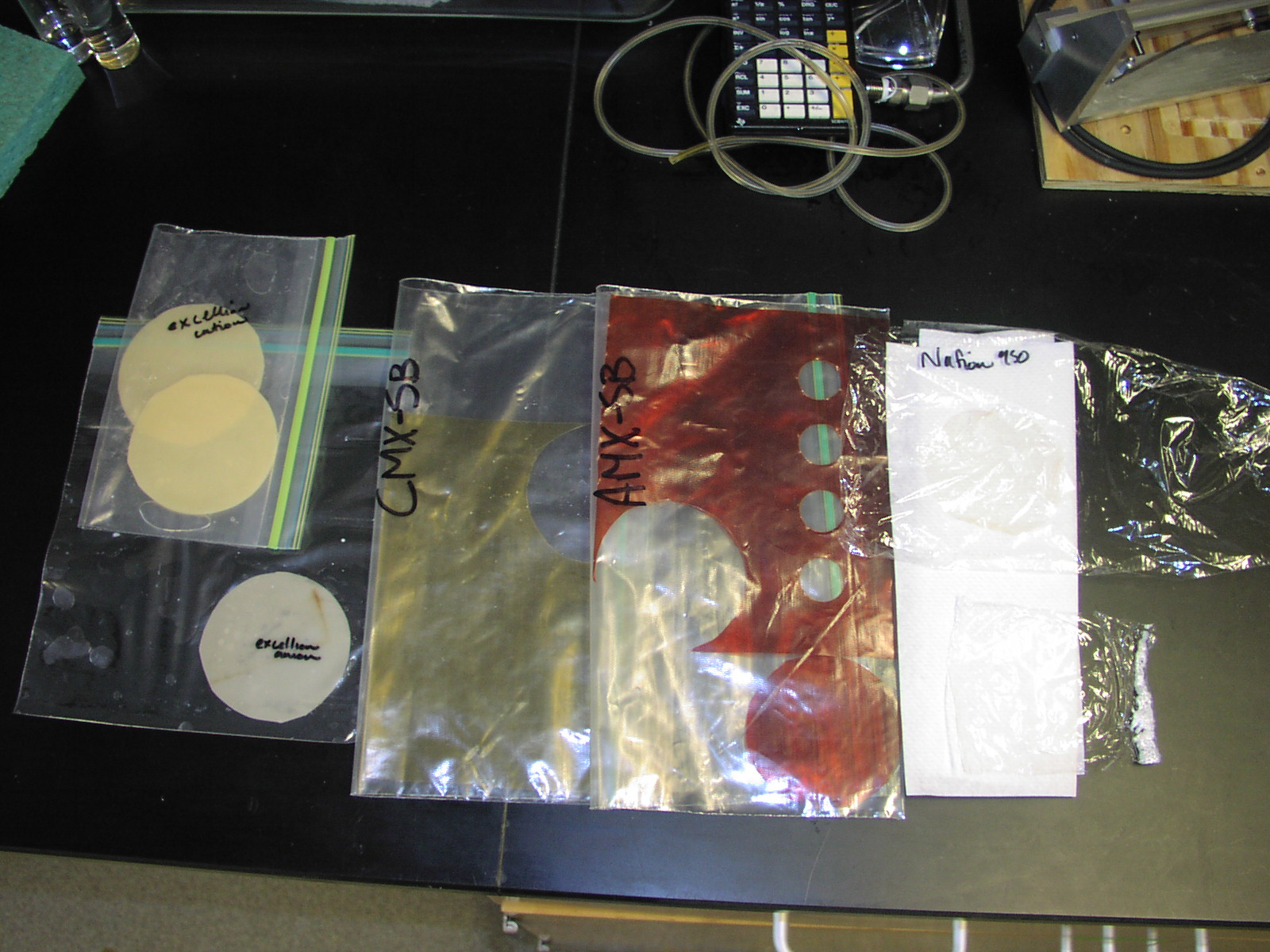
- Electropure Excellion Cation I-100
- Electropure Excellion Anion
- Ameridia Cation CMX-SB
- Ameridia Anion AMX-SB
- Nafion 950 EW (Cation)
- Cellulose Acetate membranes from a phase inversion process
|
|
7
|
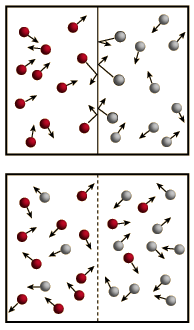
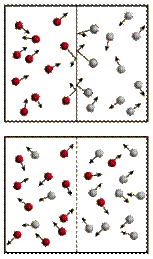
- Transport of matter across a membrane depends upon diffusion, the random
motion of molecules or colloidal-sized particles as a result of kinetic
energy; the membrane adds a frictional coefficient to diffusion.
|
|
8
|
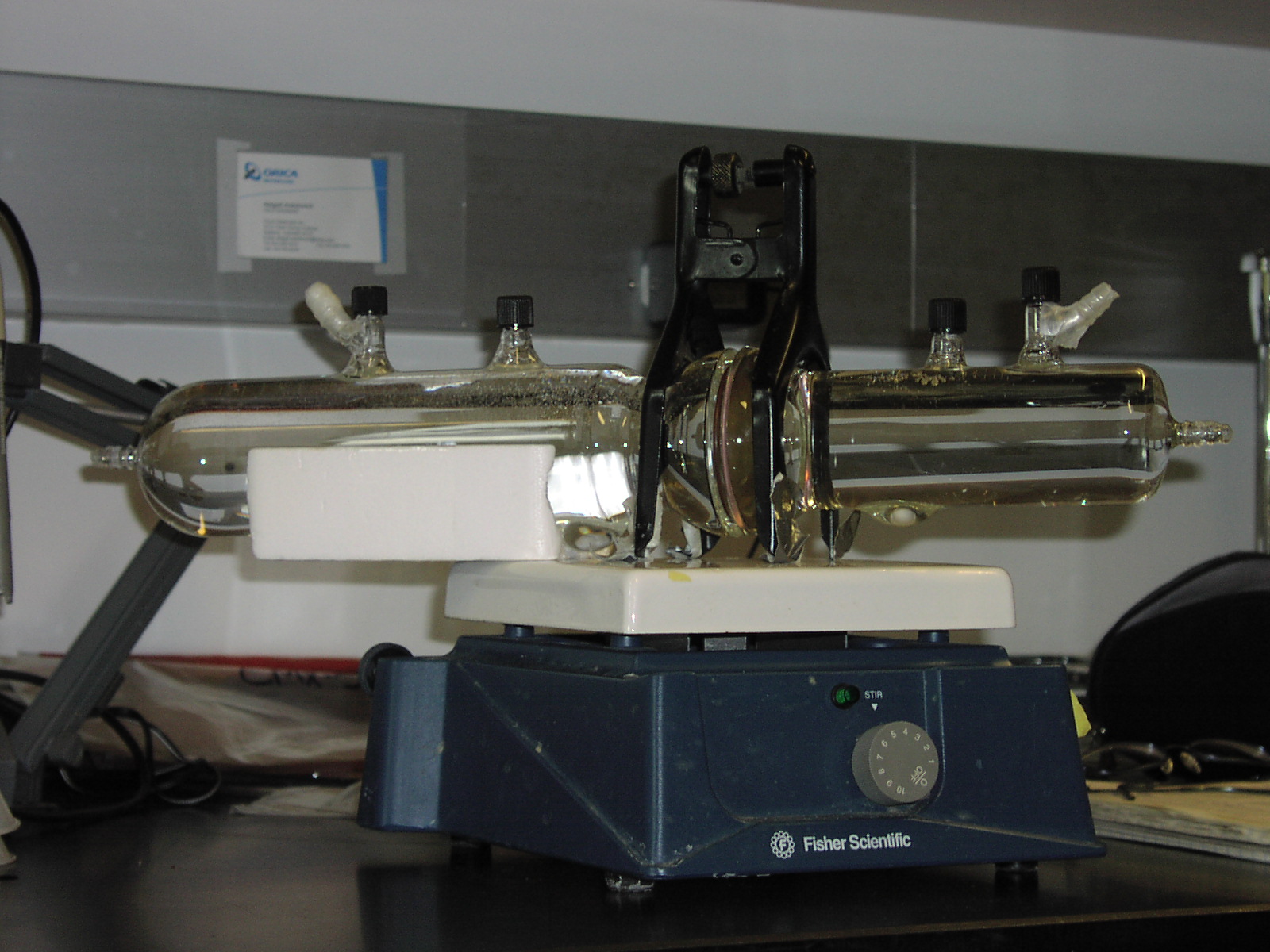
- Two sections divided by a membrane
- Stir rods in each section
- Section 1: Initially 360ml deionized water
- Section 2: Initially a solution of deionized water and NaCl at 10000
ppm, 15000 ppm, or 20000 ppm; ~840 ml
- Conductivity readings taken in ten minute intervals
- Samples removed with a syringe from lid of cell
|
|
9
|
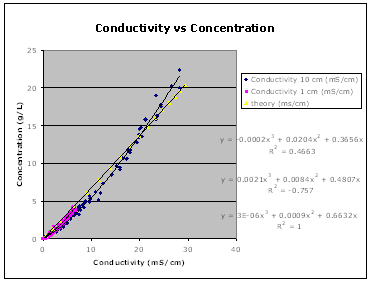
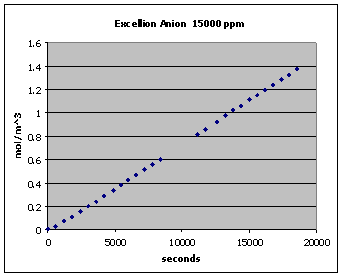
- Conductivity measurements (mS/cm) were converted to units of
concentration (g/L) by a function obtained experimentally and verified
by an accepted function.
|
|
10
|
|
|
11
|
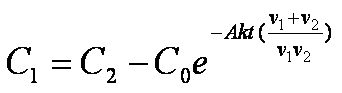
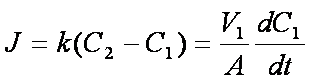
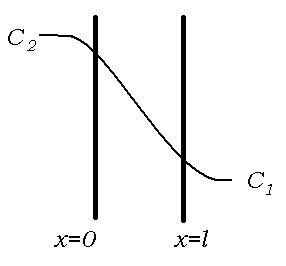
- Dependant upon the surface area and thickness of the membrane,
diffusion is described mathematically:
|
|
12
|
|
|
13
|
|
|
14
|
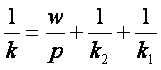
- In the Calculation of the Mass Transfer Coefficients and Permeability
Constants the following assumptions were made:
- The liquid-phase mass transfer coefficients are large
- Mass balances can be used to find concentration in one section of the
cell
- The volume in each cell changes as a linear function over time according
to initial and final volumes of each; the causes of volume change:
- Diffusion of deionized water across the membrane in both directions
- Gradual loss of volume due to sampling process
|
|
15
|
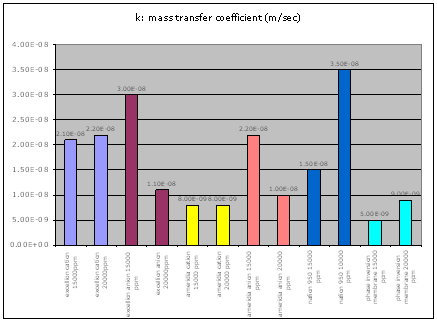
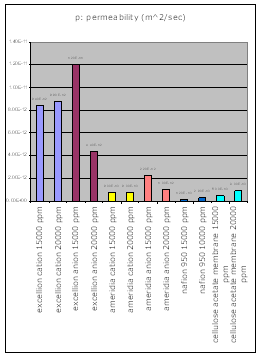
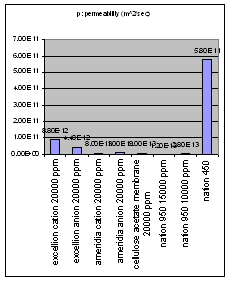
- For Excellion 44e-13< p < 120e-13
- For Amerida 8e-13< p < 22e-13
- For Nafion 950 1.2e-13< p < 2.8e-13
- For cellulose acetate membrane 5e-13< p < 9e-13
- For Nafion 450 5.8e-11
|
|
16
|
- Uses:
- The mass transfer coefficients and permeability constants will be used
for modeling in related projects that deal with electrodialysis
membranes.
- Modifications:
- Repeat existing experiment
- Use a dye like blue Dextrin, detectable by spectroscopy, to track
diffusion of water across a membrane
- Test the membranes in a different diffusion cell for comparison of
constants
- Use stir bars that have variable stir rates
|
|
17
|
- Dr. John Pellegrino
- Craig Gorman, graduate student
- Laura Richards
- Hans Anker, graduate student
- Dr. JoAnn Silverstein, REU director
- Joy Jenkins, REU coordinator
|

 Notes
Notes